
Date: 23 April 2026
Author: Jess Clark
Medical experts still cannot explain how Chris survived the incident, which left at the bottom of the North Sea with no air for more than 30 minutes.
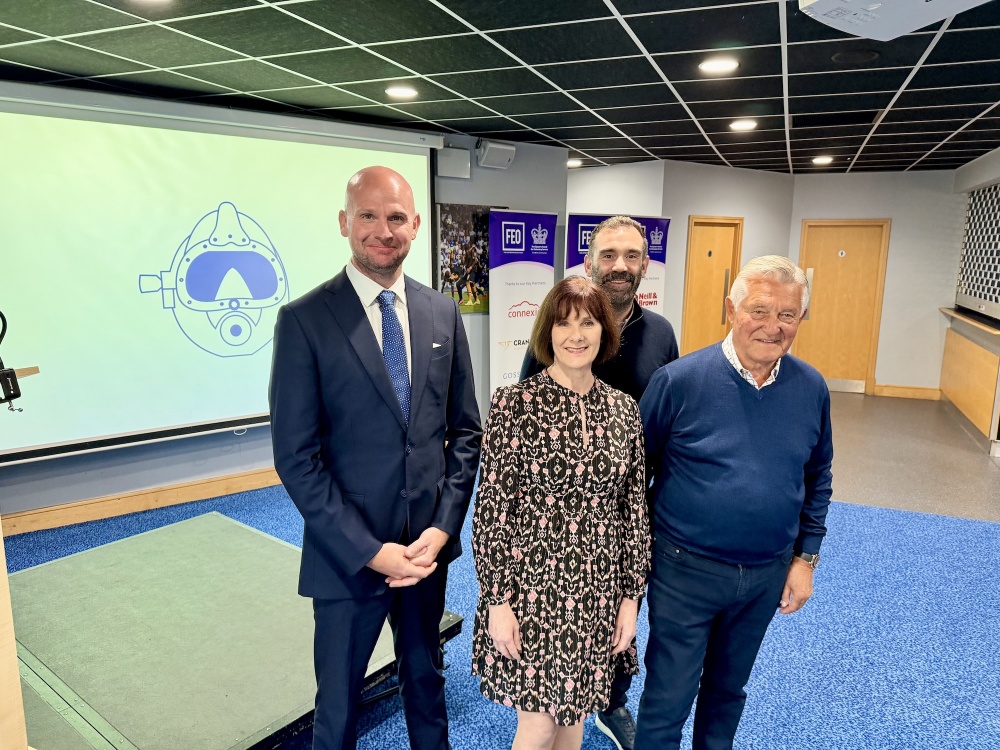
At FEO’s Guest Speaker Lunch, commercial diver Chris Lemons took FEO members and their guests on a rollercoaster ride of emotions, sharing one of the most extraordinary survival stories in modern offshore diving - but what stayed with the room was not drama or self-importance, but his humility. Chris, whose 2012 North Sea ordeal inspired the documentary Last Breath and a later film adaptation, explained the science behind saturation diving and the preparation, teamwork and quiet strength required to survive when everything goes wrong.
Chris began by explaining saturation diving, a highly specialised form of offshore work where divers live in pressurised chambers for up to 28 days at a time, travel to the seabed in a diving bell, and work in tightly controlled conditions at around 100 metres below the surface. He described a world that is far from glamorous, where routine, discipline and constant attention to safety are essential, and where a large support team of around 100 people in the vessel above, works behind the scenes to regulate breathing gas, temperature, humidity and day-to-day living.
He also gave a vivid sense of the environment itself: cramped chambers, long shifts, minimal privacy and strict procedures, all of which make saturation diving physically demanding and psychologically unusual. In Chris’s words, it is a place where you have to trust the system, trust the people around you and accept that once the door closes, decompression cannot be avoided no matter what happens.
The incident took place in September 2012 while Chris was working in the North Sea at a depth of roughly 100 metres. As he described it, the vessel above suffered a catastrophic dynamic positioning failure, drifting in rough weather and severing the umbilical that supplied him with breathing gas, light and heat.
In his talk, Chris described the moment he was pulled backwards off the structure and landed in complete darkness on the seabed, disoriented and unable to see even the shadow of his own hand. He recounted the instinctive drive to find the diving bell, the moments of confusion and the split-second decisions that followed as he fought to orient himself in pitch black water.
He explained that, after feeling his way back to the structure, he managed to climb upward by gripping a pressure-testing hose that had fallen down from the vessel and happened to be strong enough to support him. When he reached the top, he expected to see the diving bell and rescue lights above him, but there was nothing there. That was the moment, he said, when the event shifted from frightening to truly life-threatening.
As the vessel drifted further away, Chris was left with only the emergency gas in his bailout cylinder. He said he could feel the clock running down and realised quickly that his chances of survival were shrinking fast. What struck him most in that moment was not panic but a strange calm, alongside the dawning awareness that he might not make it back. This ordeal was caught on camera as Chris’ unconscious body jerked and twitched.
Up in the bell, the crew were trying to recover his umbilical while the vessel’s systems were failing around them. Chris’s colleague Duncan remained in the bell, initially unaware of the full scale of the disaster because the snapped umbilical had cut communications, but he continued to pull in the line and then the broken end of the gas hose, confirming that Chris was missing and likely in extreme danger.
The boat’s crew eventually regained control of the vessel by resetting the system - he joked they literally turned it off and on again - allowing them to manoeuvre back over the divers’ position. By then, around 35 to 40 minutes had passed since he had run out of breathing gas. Fellow diver, Dave was able to get back to him, reconnect, and haul him to the diving bell, where Duncan took over and brought him inside.
Chris described being bright blue, but revived with just two breaths once he was in the bell, before eventually climbing back into the chamber under his own steam. The crew then warmed him carefully, wrapped him in blankets and monitored him while the boat began its slow decompression back to the surface. Against all expectations, he suffered no lasting physical injury.
One of the most powerful parts of Chris’s talk was his reflection on trauma. He explained that the divers directly involved in the incident did not experience the event as traumatic in the same way outsiders might imagine, but that many people on the surface who watched it unfold on screens around the vessel were deeply affected. Some left the industry afterwards, and others carried the emotional impact for years.
That honesty gave the audience a deeper understanding of what crisis really does. As Chris made clear, the person at the centre of an emergency is not always the only one carrying the weight of it; sometimes the people trying to help, or simply witnessing events from a position of helplessness, are the ones most affected.
He was equally clear that he does not see the incident as a miracle story or a piece of hero worship. Instead, he describes it as a success story - one built on preparation, calm leadership, disciplined procedure, teamwork and resilience. Throughout his talk, Chris remained humble, practical and deeply human.
Chris ended by sharing the lessons the diving industry learned from the incident, including the importance of robust reporting, realistic drills, clearly defined roles, calm leadership and a culture where people are invested in safety rather than simply ticking boxes. He argued that real preparation gives people the confidence and mental space to make difficult decisions when the unexpected happens.
It was a reminder that resilience is rarely about one heroic moment. More often, it is about systems, people and habits working together under pressure, and about remaining clear-headed when circumstances are anything but clear. In that sense, Chris Lemons’ story is not only remarkable because he survived, but because it shows how much can be achieved when people prepare well, communicate well and refuse to give up on one another.
Check out the documentary trailer HERE and the film, with Woody Harrelson can be found on Prime or Netflix.







Email:
info@forentrepreneursonly.co.uk
Address:
For Entrepreneurs Only Quarry House, Hesslewood Office Park, Hessle, East Yorkshire, HU130LH