
Date: 20 August 2026
Author: Jess Clark
But at FEO’s What’s Your Exit Strategy? workshop, the message was clear: it is not something to leave until the end of the journey.
Whether you want to sell your business, pass it to family or colleagues, attract investment, step back from daily operations or simply create more freedom, getting there takes time, planning and purposeful decisions.
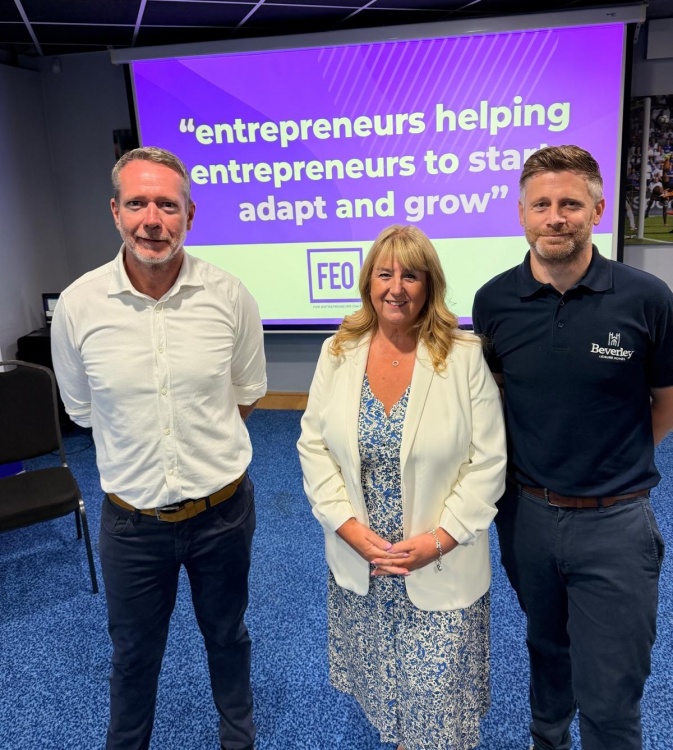
FEO member, James Chandler of Raymond James, FEO Chair David Hall of Beverley Leisure Homes and FEO Director Angela Oldroyd of The Promotion Company, shared their own experiences - including successes, mistakes and lessons learned along the way.
As with every FEO session, it was not theory. It was practical experience from entrepreneurs helping other entrepreneurs start, adapt and grow.
James began by challenging the idea that success always means growing quickly, taking on bigger premises or employing more people.
Instead, he encouraged members to take a longer-term view. The priority should be to create a business with strong financial foundations, a healthy balance sheet and the ability to generate value without relying entirely on its owner.
That might involve growth, but it could equally mean restructuring, diversifying, becoming more selective or improving efficiency. The key is to make changes with purpose: building resilience, creating options and shaping a business that supports the life you want to lead.
Angela spoke about the value of strong business practices, processes and systems.
For her, it is not about creating policies that sit unused in a drawer. It is about having the information, structure and consistency needed to understand the business, make sound decisions and remain in control.
It also extends to reputation. Are employees supported and valued? Do customers receive a consistent service? Do suppliers find the business reliable and easy to work with?
All of this adds value.
Angela compared it to selling a house. A well-maintained property, with proper records of improvements and work completed, is far more appealing to a buyer. A business is no different.
Angela also highlighted the importance of monthly management accounts.
The purpose is not necessarily to examine every single line of a report. It is to identify changes early and ask the right questions. Are particular customers spending less? Is one product line growing? Is cashflow coming under pressure? Where are the opportunities?
Good information helps a business respond quickly when challenges arise. It also creates confidence for anyone considering investing in, buying or taking over the company in the future.
David spoke openly about Beverley Leisure Homes’ rapid expansion after Covid.
The business took on another 20,000 sq ft of factory space and grew at pace. However, the systems, financial information and culture did not always keep up with that growth.
His key question was whether a business is growing profit, cash and value - or simply turnover and risk.
More sales can mean more stock, more debtors, additional people, bigger premises and greater commitments. Without the right controls, rapid growth can place strain on a business and its team rather than strengthen it.
David’s experience was a reminder that bigger is not automatically better. Sometimes the better decision is to improve margins, strengthen cashflow, restructure or remain at a size that is profitable, manageable and compatible with the owner’s life.
For David, having a clear personal end goal has changed how he looks at the business.
Rather than chasing turnover for its own sake, he works backwards from the desired destination. What should the business look like? How many people are needed? What production capacity is required? Which customers does it want to serve?
He compared it to commissioning a piece of furniture. If you give a joiner a clear picture of what you want, they know what to build. If you create that same picture for your team, suppliers and customers, they can understand where they fit and how they can help move the business forward.
James also reminded members that selling a business is not the only exit route. Other options can include succession planning, a management buyout, selling part of the company over time, building assets outside the trading business or operating a lean, profitable lifestyle business.
The message from the workshop was simple: start early, know your numbers, build systems that reduce dependence on the owner and be clear about what you are building towards.
Do that, and when the time comes, you are far more likely to have choices.
If you would like to apply for FEO membership, please visit HERE.









Email:
info@forentrepreneursonly.co.uk
Address:
For Entrepreneurs Only Quarry House, Hesslewood Office Park, Hessle, East Yorkshire, HU130LH